
A recent engagement that touched on Digital Transformation brought to mind an article I had developed in the early 2000s, and then republished in 2017. The article was about what I call IT Stance. Below is a slightly updated version.
Does your investment in IT match your business needs? One of the sources of disconnect between business leadership and IT that I regularly see is a lack of agreement as to how aggressive the firm’s investment in IT should be. I refer to this leaning as the firm’s IT Stance. Alignment on stance can help defuse much of the tension and frustration between IT and the business. Being able to explain and conceptualise the difference in thinking is, at least, valuable.
With firms focused on Digital Transformation, this issue continues to be current. Whatever the driver for IT investment in your firm, I believe IT Stance remains an important concept for managers to understand.
I developed the ideas here over 20 years ago while undertaking a consulting engagement for a large New Zealand corporate. I have not found an alternative articulation, although I would welcome it. Let me know if you think this idea is the same as (or very similar to) anything else you have come across.
The challenge posed by my client was this: the firm’s IT team were attempting to justify a significant increase in the level of IT expenditure across the firm, but the Board could see no justification. The matter was somewhat deadlocked. The CIO was painting a picture of strategic benefits to the firm through the adoption of new technologies that would have the potential to elevate the firm’s competitive standing. Management could not see the promised benefits, somewhat gunshy from the failure of the last major technology investment.
You don’t need to have read Everitt Roger’s 1962 seminal work The Diffusion of Innovations to understand his model describing how, why, and at what rate new ideas and technology spread. The model with updated language was popularised by Geoffrey Moore in his book Crossing The Chasm.
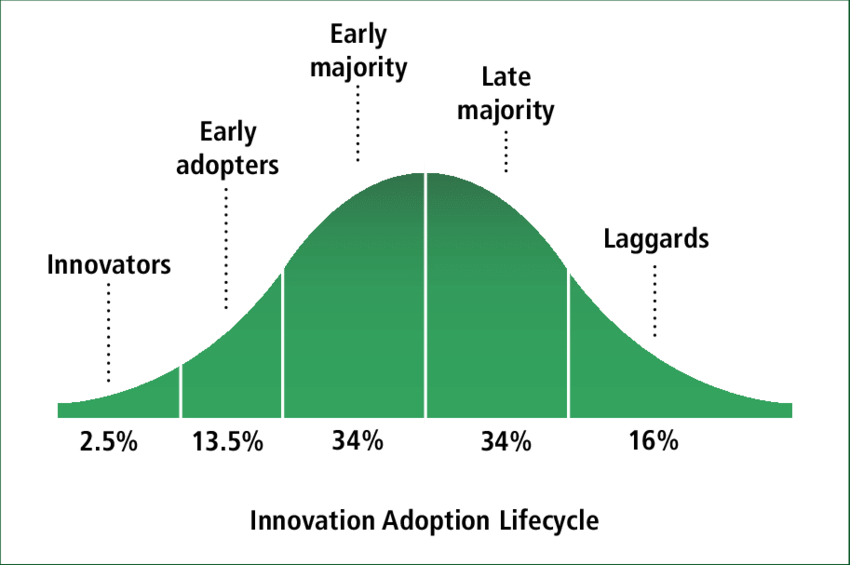
In Roger’s model, technology adopters are categorised into one of five groups, recognising the differences in the willingness of firms (or individuals) to be reliant on unproven or novel technology: Innovators, Early Adopters, Early Majority, Late Majority, and Laggards.
We then ask two questions independently:
- Where on this curve do company leadership believe the organisation should be?
- Where on the curve do IT leadership believe the organisation should be?
The gap between these two positions highlights the lack of alignment often seen in firms between these two groups.
In considering your IT stance, you are making a deliberate choice as to your approach and level of investment in digital technology. I firmly believe company management need to decide where they want the firm to be, rather than leaving this to the IT function or to the firm’s IT suppliers. And despite what your suppliers might tell you, there is no right position on this curve.
IT Stance is a highly subjective interpretation of your position on the curve rather than a formula-based assessment. It is more important to motivate the internal discussion of where your firm should sit than to split hairs as to whether you are at the 40% mark or the 44% mark.
At the Movies
Let’s look at an example of how we can make deliberate choices using Roger’s model. We will use seeing a particular blockbuster movie as our analog. We can draw parallels between how we choose to see a movie and the technology adoption curve:
- Innovators want to be first, irrespective of the cost or risk. This is akin to spending more to going to a gala premiere even before any reviews have been published. Will it be a good film? Will it be worth the money? Choosing this position is typically deliberate, and comes at a premium.
- The next cohort, the Early Adopters, also want to get in early, but wait for feedback from their Innovator friends. They go to see the movie on the opening weekend: no spoilers! They have slightly lowered the risk of sitting through a bad experience based on feedback from Innovators, but are still paying a reasonable premium: movie tickets, parking, concession stand prices, and a babysitter.
- The Early Majority are part of the mainstream, waiting for the queues to shorten, the cinemas to be less packed, and maybe even a cinema’s promotions to get cheaper seats. They will have read the reviews, perhaps heard from friends how good the movie is. They still have the ‘night out’ premium, but can generally filter out the bad from the good. A reasonable trade-off in their mind.
- Late majority viewers go for an even lower price point, trading cost off against the time delay: streaming on Disney+ or Netflix. They pay a much lower cost than theatre-goers, but have waited perhaps six or more months to see the film. Even before the opening credits role, they will have heard Haley Joel Osment’s secret (‘I See Dead People’), and know exactly who dies in at the end of [SPOILERS!]. But the lower cost and convenience outweigh the value of surprise: the popcorn is much cheaper, they can pause the movie to get another drink, and no babysitter required.
- The tail of the curve are the Laggards. For them, paying to see this movie is an unnecessary luxury, and they would rather spend their entertainment dollars elsewhere. They wait (possibly for years) for the movie to be on free-to-air TV. They tolerate the frequent ad breaks for the budget, lowest cost experience, and get to filter out the dross that they wouldn’t enjoy.
There is, of course, another important choice: non-consumption. I might choose to never see the movie. The curve captures those that consume, and in reality the laggards are a long tail.
An important consideration here is that each of these positions is valid, and are generally deliberate positions movie-watchers make. Similarly, each position on the IT adoption curve is valid, and should be the result of deliberate choice.
In the movie example here, there is a tradeoff between the cost of the experience and time. This is a common tradeoff being made by individuals and firms when acquiring technology as well.
Another aspect to note is that where you might sit on the curve will probably change depending on the movie. You are not always an innovator with technology.
Applying the Model
I find the language used in the model to be in favour of the top 50%. Being part of the Late Majority can itself be seen to be a negative. Being a Laggard is something to be avoided, akin to being branded a Luddite. But MATH! means in every industry there will be laggards, by definition, even if that lateness is a matter of months, rather than years or decades.
Irrespective of the language, my experience is that IT teams overwhelmingly believe their firm should be in the top 50%, and ideally in the top 5% – 20% mark. People who work in IT tend to have a very positive view of IT innovation, which is understandable. Most IT folk describe themselves personally as Innovators or Early Adopters.
IT staff want to work for firms that recognise the opportunities from digital technology, the firms that are willing to compete through IT investment. IT staff believe firms should be adopting new technologies sooner, viewing these technologies as inevitable, necessary, and offering competitive advantage.
Vendors, of course, are selling at the front of the curve. Their salespeople are incentivised on selling the latest toys with the fattest margins. Early in the product life cycle, vendors get away with proprietary solutions that lock you in to them for the life of the purchase. Vendors feed the technophilic tendencies of your IT staff with impressive new gadgets and case studies of successful early adopters. They co-opt your own staff to be their product champions.
Businesspeople, on the other hand, are generally more cynical in their experience of digital investment. As a result, managers are more likely to be in favour of their firms being in the bottom 50% (even more definitively if more neutral terms for ‘laggard’ are used). Even if an individual manager is themselves an early adopter of technology, this does not necessarily translate into their view of where the firm should be. The main outliers here are start-ups.
What is it like being part of the other (late) half? The late majority is characterised by adopters who wait for the technology hype to have abated, and for the technology to be a part of the mainstream: standardised and commoditised products, offered by a range of suppliers with little vendor power, requiring mainstream skillsets to design, deploy, and use. These firms spend less, but forego the potential upside of exploiting new technologies earlier in their lifecycle.
Aligning stance
Using IT stance in a business is not a matter of finding a middle ground between the two camps. I have used IT stance to re-calibrate the expectations of IT teams as to the view and expectations of their business leadership. Alignment in almost every case is achieved by IT shifting their stance rather than the business shifting theirs – but it can happen.
These are not easy discussions. IT managers want to believe their influence on the firm and the value of IT innovation is much greater than it really is. Bursting that bubble is a necessary step to realignment. IT teams need to reorient their approach to successfully delivering value in the mainstream, matching the business expectations.
Be prepared: The change in IT mindset is sometimes achieved through a change in personnel. I have dealt with some IT managers who are so locked into their approach that they believe IT’s role is to direct the business.
Using IT stance leads to discussions that are intended to be a starting point to achieving alignment between the business and IT. It is a simple model to illustrate the gap that exists in businesses. At the least it is useful to help explain the disconnection. There is no formula for calculating your stance, and there is no formula for how to move to alignment even once the delta between the two positions – IT’s and the business – has been articulated.
When you and your firm are considering digital transformation initiatives, you need to be clear and aligned on your expectations as to your IT Stance.
An earlier version of this article appeared in the June 2017 edition of the Staples Rodway magazine ‘Numbers.’